Marcus Kinsey 3114 AS Film Coursework
Thursday, 14 April 2011
Evaluation
1) In what way does my media product use, develop or challenge forms and conventions of real media products?
I have made a storybroad of the key scenes from my final media product. In this storyboard I have discuss, the title, mise-en-scene, sound, camera work and editing. I have also talked about how this product resembles conventions of real media product:
2) How does your media product represent particular social groups?
Our media product didn’t directly go out to challenge or represent any particular social group we wanted a feel of this could happen to anyone, however if you had to argue how it represented a social group i would say it represented the lower class in a negative light however it does aim to make you see things from their perspective.
3) What kind of media distribution might distribute my media product and why?
I would say that the film product that we made would be from an independent film company, because we worked to a very small budget (just like most independent companies do). Evidence to back up for why we had a low budget is the prop scheduler. The main props we used were a phone, car and furniture (from someone’s house).
5). How does my opening scene attract/address my audience?
The opening scene was very important for us as it is designed to captivate an audience and get them 'involved' in the film. We thought if we had a dramatic, somewhat mysterious opener we would encourage verisimilitude as quickly as possible. As said it was designed to be dramatic, confusing, mysterious, energetic and sinister.
6). What have I learnt about technologies from the process of constructing this product?
I have learnt about all the tiny technological details involved in making a film, from making sure angles don't look dodgy by implementing specific angles to the arduous logistical plans so that everything comes together as smoothly and efficiently as possible. My video editing skill has certainly improved.
7) Looking back at my preliminary task, what do I feel I have learnt from the progression from it to the full product?
The Preliminary was very basic and therefore simple, I have learnt that in order to make something a bit more interesting you have to think bigger and be prepared for the unexpected. This certainly applies for the outside scenes, clouds come and go, shadows move, birds start singing. Factors such as those are by-passable when filming inside as we did with our preliminary
Through the process of making this film I have learnt a lot about making a film.
Thursday, 7 April 2011
PRODUCT: The making of our Product
During the shoot days, we had to ensure that the footage we got was perfect. This required many re shoots and the occasional argument. Following is a video showing our attempts at getting it all just right.
Thursday, 31 March 2011
PRODUCT: Final Product
After the film had been shot, edited and finalised, we ran it through an audience reception, and made a number of changes, such as the saturation and light levels of the film, and tightened up a number of scenes, making the whole film feel more fast-paced.
After we were happy with this, we uploaded it to Youtube, and burnt the final product onto a CD. Here is our product in its' final, ready for release form.
PRODUCT: Shooting Schedule
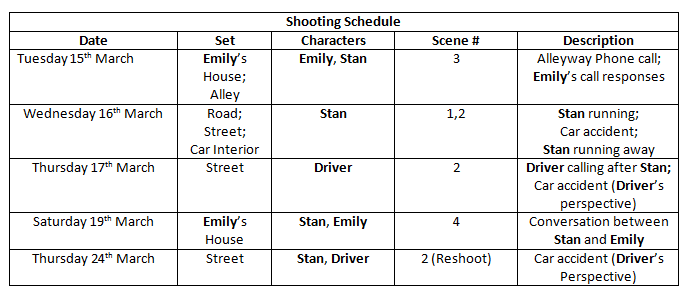
We shot our film over a five day period (Ten, if re-shoots are counted). This required a shooting schedule to be made to ensure that we could shoot scenes at times that were convenient for our actors. We made the shooting schedule after having a meeting with our group and the actors we were going to use over Skype, which enabled people to check their availability for that day.

This is the finalised shooting schedule (With the re-shoot added retrospectively).
The scene had to be re-shot because the lighting for the day was too different to the proceeding shot of Stan running towards the car... that and...in a moment of genius, we forgot to have Stan in the Driver perspective shot.
Thursday, 17 March 2011
TARGET AUDIENCE RESEARCH: BBFC Classification
The BBFC (The British Board of Film Classification)
The BBFC is a non-governmental organisation in the UK that gives out certifications for media distributed in the UK. Unlike other international certifications it is a compulsory obligation for distributors to sell a game to a person of the right age. Where certifications issued by companies such as PEGI are simply advisory and are issued to advise consumers, BBFC targets the distributors.
HISTORY
The British board of film classification was formed in 1912 and was known as the British board of film censors this was because the film industry at the time preferred to manage the classification and censorship of their own films rather than have them enforced by governments, the BBFC do have power to fine and in extreme cases close down organisations who breach the regulations set organisation changed its name to the British board of film classification the BBFC were also used to prevent negative propaganda during the second world war, in 1984 the organisation changed it t to its current name the British board of film classification, in 1986 however the BBFC rated its first video game as a 15, video games are however video games are voluntarily submitted for classification, in 1997 the first game to refuse being rated by the BBFC was ‘’Carmagedon’’ however a later version of the game was rated and it received a 18 certificate, and in June 2007 the game Manhunt 2 was refused a rating and so deemed illegal to sell.
The video recording act of 2010
This act brought back into force some parts of the video recording act of 1984, this was because the European commission had not been notified in 1984 of this act which directly affected the classification and distribution of films in the U.K and therefore due to the lack of information provided to the European commission this act was deemed unenforceable and therefore on the 15th December of 2009 this act to revive the provisions of the video recording act of 1984 was presented to the house of commons, subsequently the second and third reading of this act both took place on the 6th January 2010 and so on the 21st January of that year the act received royal assent and is still in force today.
Subscribe to:
Posts (Atom)