Thursday, 14 April 2011

Evaluation


1) In what way does my media product use, develop or challenge forms and conventions of real media products?

I have made a storybroad of the key scenes from my final media product. In this storyboard I have discuss, the title, mise-en-scene, sound, camera work and editing. I have also talked about how this product resembles conventions of real media product:

2) How does your media product represent particular social groups?

Our media product didn’t directly go out to challenge or represent any particular social group we wanted a feel of this could happen to anyone, however if you had to argue how it represented a social group i would say it represented the lower class in a negative light however it does aim to make you see things from their perspective.

3) What kind of media distribution might distribute my media product and why?

I would say that the film product that we made would be from an independent film company, because we worked to a very small budget (just like most independent companies do). Evidence to back up for why we had a low budget is the prop scheduler. The main props we used were a phone, car and furniture (from someone’s house).

5). How does my opening scene attract/address my audience?
The opening scene was very important for us as it is designed to captivate an audience and get them 'involved' in the film. We thought if we had a dramatic, somewhat mysterious opener we would encourage verisimilitude as quickly as possible. As said it was designed to be dramatic, confusing, mysterious, energetic and sinister.


6). What have I learnt about technologies from the process of constructing this product?
I have learnt about all the tiny technological details involved in making a film, from making sure angles don't look dodgy by implementing specific angles to the arduous logistical plans so that everything comes together as smoothly and efficiently as possible. My video editing skill has certainly improved.


7) Looking back at my preliminary task, what do I feel I have learnt from the progression from it to the full product?
The Preliminary was very basic and therefore simple, I have learnt that in order to make something a bit more interesting you have to think bigger and be prepared for the unexpected. This certainly applies for the outside scenes, clouds come and go, shadows move, birds start singing. Factors such as those are by-passable when filming inside as we did with our preliminary
Through the process of making this film I have learnt a lot about making a film.

Thursday, 7 April 2011

PRODUCT: The making of our Product

During the shoot days, we had to ensure that the footage we got was perfect. This required many re shoots and the occasional argument. Following is a video showing our attempts at getting it all just right.

Thursday, 31 March 2011

PRODUCT: Final Product

After the film had been shot, edited and finalised, we ran it through an audience reception, and made a number of changes, such as the saturation and light levels of the film, and tightened up a number of scenes, making the whole film feel more fast-paced.

After we were happy with this, we uploaded it to Youtube, and burnt the final product onto a CD. Here is our product in its' final, ready for release form.


PRODUCT: Prop schedule

PRODUCT: Shooting Schedule

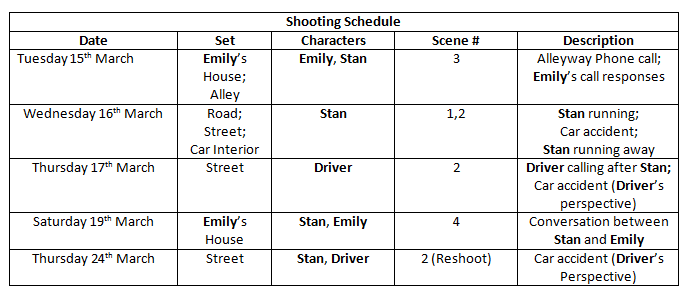
We shot our film over a five day period (Ten, if re-shoots are counted). This required a shooting schedule to be made to ensure that we could shoot scenes at times that were convenient for our actors. We made the shooting schedule after having a meeting with our group and the actors we were going to use over Skype, which enabled people to check their availability for that day.


This is the finalised shooting schedule (With the re-shoot added retrospectively).
The scene had to be re-shot because the lighting for the day was too different to the proceeding shot of Stan running towards the car... that and...in a moment of genius, we forgot to have Stan in the Driver perspective shot.

Thursday, 17 March 2011

TARGET AUDIENCE RESEARCH: BBFC Classification

The BBFC (The British Board of Film Classification)


The BBFC is a non-governmental organisation in the UK that gives out certifications for media distributed in the UK. Unlike other international certifications it is a compulsory obligation for distributors to sell a game to a person of the right age. Where certifications issued by companies such as PEGI are simply advisory and are issued to advise consumers, BBFC targets the distributors.


HISTORY

The British board of film classification was formed in 1912 and was known as the British board of film censors this was because the film industry at the time preferred to manage the classification and censorship of their own films rather than have them enforced by governments, the BBFC do have power to fine and in extreme cases close down organisations who breach the regulations set organisation changed its name to the British board of film classification the BBFC were also used to prevent negative propaganda during the second world war, in 1984 the organisation changed it t to its current name the British board of film classification, in 1986 however the BBFC rated its first video game as a 15, video games are however video games are voluntarily submitted for classification, in 1997 the first game to refuse being rated by the BBFC was ‘’Carmagedon’’ however a later version of the game was rated and it received a 18 certificate, and in June 2007 the game Manhunt 2 was refused a rating and so deemed illegal to sell.


The video recording act of 2010

This act brought back into force some parts of the video recording act of 1984, this was because the European commission had not been notified in 1984 of this act which directly affected the classification and distribution of films in the U.K and therefore due to the lack of information provided to the European commission this act was deemed unenforceable and therefore on the 15th December of 2009 this act to revive the provisions of the video recording act of 1984 was presented to the house of commons, subsequently the second and third reading of this act both took place on the 6th January 2010 and so on the 21st January of that year the act received royal assent and is still in force today.

TARGET AUDIENCE RESEARCH: Film Poster Reception

TARGET AUDIENCE RESEARCH: Film Poster

Here is our final film poster. We used the cigarette pack to represent the gritty and urban feel that the film has. The poster has been kept minimal so that it has a clean feel about it. The whole poster has been styled in way that nods to The Velvet Underground and Niko album cover by Andy Warhol.

TARGET AUDIENCE RESEARCH: Film Company Logo Reception

TARGET AUDIENCE RESEARCH: Film Company Name and Logos

An important part of film production is a name. This allows people to recognise your company from others, and hopefully sets the company apart. The name of our company went through many different phases, from American sounding ones, such as Westroad Productions, ambiguous ones such as Tailor Film, and downright ridiculous ones, such as Imagico Film Productions.

After a few hours of arguing, and a trip to The Ward Arms, we decided to leave the name of the film company to whoever made the logo, and thus, our film company was named Reelhaus Productions.

This name was chosen because it harks back to the German Expressionism movement from Weimar Germany in the 1920's, and because... it sounds good. Bit of German really adds a kick to the name, yes?

All film companies have a distinct logo, which is designed to embody the values that the company holds. That and... 

Well, you need a logo, don't you?

We began the planning of our company logo by first looking at some existing ones.


Looking at these, we deduced that film companies tend to use a form of symbolism with their logos for a number of reasons, be they for nature of film, values of the company, or just because it looks good. From this, four distinct logos were made.

Our first logo was made to be eye catching and practical:

Our second logo was made to hark back to Indie amateur film companies from the 1980's:

Our third logo was made to be eye catching, imposing, and drew influences from propaganda from Fascist Italy.

Our fourth and final logo was created to have a warm, social and modernist style to it.

We then put these logos up on SurveyMonkey, and asked people from sixth-form for their receptions of each, and used this to decide a final logo.


TARGET AUDIENCE RESEARCH: Storyboard Survey

For our storyboard, we have decided that we should continue to do some target audience research in order to find out what other people thought of our ideas, and to see what they believe constitutes to a successful film opening. We did this by going constructing a questionnaire and asking members of the sixth form (Our films' target audience is the 16-18 demographic, so students from sixth form fit well into this), we decided that it would be better for us to ask other people the questions and write their answers on the questionnaire. This means people that will be more likely to give proper answers instead of messing our results around, something we found to be the case when using online survey sites, such as Surveymonkey.


Our first question regarded the gender of our target audience. This allows us to change the direction the film takes in certain situations to cater better to the audience.


This question was used to get a basic feel of what people thought of the storyboard. We did this to ensure that we knew where we stood with people who would be watching out film.


This question was used to ensure that the aesthetic qualities of the film setting followed the conventions of our genre.


Although ambition is important, it serves well to ensure that ones' film idea is grounded in reality. This question was asked to see if people believed that our film would be achievable, given the restrictions of being for coursework, not for art or money.


These photos are of members of our group collecting the data for this survey.

RESEARCH: Preliminary Conclusions

RESEARCH: Directors' Pitch


Grit and action have become a winning formula in the film industry in recent years. Films such as The Dark Knight and Harry Brown are good examples of the application of grit in an action film. We intend to reflect this trend with our film.

Set in Northampton, we will be working closely with the results from our questionnaire to develop a film that suits our target audience- the 16-19 teenage demographic. This will be reflected in the characters used in the film. The central characters will be in roughly the same age band as that of the target audience, which will hopefully allow them to bond with the characters better.

The results from the questionnaire have shown that a number of the sample found Aesthetics to be important in a film. We will work to this by using high dynamic range imaging, gritty camera filters, and vignetting, seen in such programmes as Top Gear to add drama to each shot. The use of vignetting also makes the scenes become more claustrophobic, adding some thrill factor to the chase scenes.

The first two minutes of the film itself with focus on the main character, a youth of around 16-18 years fleeing pursuers in the streets of Northampton. The establishing shot will be of the main character, and will allow the audience to focus on the blood on his shirt, and the sweat and stubble on his face, establishing that this chase has been happening for an extended time.

The following shots will consist mainly of the chase, interspersed with credit screens. There will be no non-diagetic sound in the chase, which establishes to the audience that the drama of this film will happen at a realistic level, with no hints of super or action hero influences. The scenes of the main character running will feature ambient sounds, but the sound of his fatigued and heavy breathing will be made louder. In parts where the screen shows credits, the ambient sound will be cut out, allowing the audience to hear only the breathing of the main character. This allows the audience to bond further with this character, as he appears to feature prominently. As his breathing is louder than anything else, it almost begins to push into the realms of a non-diagetic narration of events. This appears to the audience that his exhaustion is the driving factor of the entire film, adding to the action elements.

The scene ends with the main character narrowly escaping his assailants. The camera will remain focused on the assailants, showing brutal rage in their eyes, further exacerbated by the main characters' escape. The audience will be be left without any idea of why the assailants were so angry, adding to their interest to the film, and capturing their imagination.

Wednesday, 9 February 2011

RESEARCH: Initial Storyboard

i. Establishing shot - Heavy breathing is heard while the shot slowly fades to a man running. The shot will last aprox. 6-7 seconds and consist only of his feet.
ii/iii. The first of the opening credits. Currently debating on whether to keep the heavy breathing over these or not. The text will fade in.
iv. Similar to i, shot of man running, this shot will last only about 3 seconds.
v. More opening titles.
vi. This shot consists of the main character making a turn to the right and going up some steps. The shot will pan slightly as he makes the turn.
vii. Group names
viii. This shot will start with the character appearing from the right hand side of the screen. He will be walking backwards so the audience can see the front of him, he will have blood on his shirt and should give the impression that he is running from something. He will then jump over a fence behind him.
ix. During the same shot the camera will move forward with the character as he jumps over the fence. Then quite loudly (probably through use of sound effects) a car will appear from the right will collide with the main character. During viii and ix smaller opening credits may appear.
x. The scene will cut to a shot of a man getting out of a car, he will ask if the man on the ground is okay.
xi. The shot then cut to a POV shot in which our main character will appear dazed. He will then get up and begin to run to the right. Smaller opening credits will stop here if introduced.
xii. The scene cuts to the main character running off, possibly telling the man in the car he is fine.
xiii. The scene then cuts back to the same angle before of the man in the car. He will mutter something under his breath and look dismayed and then get back into his car. Upon the door slamming shut the scene will instantly cut to a room with a lady in it. Not sure what she should be doing in the room, it might be a good idea to avoid her doing housework, someone might complain for all we know. A phone will ring and she will walk over to it.
xv/xvi/xvii/xviii/xix. Brief conversation on the phone, it should be understood at this point that the main character and this secondary character are or were engaged in a relationship. MC as we shall now call him for convenience purposes will more or less force invite himself round her apartment. The shot will consist him running towards the camera head on while the camera maintains distance. BeforeSC can say otherwise, he hangs up leaving her saying "hello?" and then looking at the phone in confusion.
xx. Scene cuts to a birds eye shot of the MC running up a set of stairs.
xxi. Shot of MC coming through the apartment door with a brief shreak from SC, the camera pans right and MC exits to the left of the screen.
xxii. From the right MC walks towards a door and goes in.
xxiii. These shot will make use of a canted angle to represent confusion as nobody other than MC knows what is going on. He will turn the tap, take off his bloody shirt and then lean over the sink until he turns them off when the sink is full.
xxiv. Over the shoulder shot as he splashes water over his face and then he will begin to dunk his head in the water.
xxv. Shot shows his face entering the water following shot xxv. He then exits the water.
xxvi. Shot then cuts to the shown shot and SC appears round the door.
xxvii/xxviii/xxix/xxx/xxxi/xxxii. Contrary to the dodgy story board pictures the couple then engage in conversation. Something along the lines of what has just taken place. The two minutes of filming should at this point be complete

This is our initial storyboard. Later on we will be making changes to it to fall in line with what our target audience research suggests.

RESEARCH: Audience Research Analysis

RESEARCH: Audience Research

Before a film project can be undertook, it is apparently necessary to perform some audience research. This allows one to decide what direction should be taken with the film in order to "Get" the audience. Of course, if one is undertaking a film project that is true to their own vision, this research would not be needed. However, as this film is undertook to receive as high a grade as possible, this research will be useful.

The questions asked and the results were...
1) Are you...
     Male?   [12]     Female?   [8]

2) How old are you?
    15 or under  [1]    16-18  [17]   19-21 [2]

3) Do you enjoy films?
   Yes  [19]    No  [1]

4) What is your favorite genre of film?
   Action                       [6]
   Horror                      [5]
   Comedy                    [4]
   Adventure                 [2]
   Science-Fiction         [3]
   Romance                  [0]
   Other...                    [2] (Thriller and War were given, and have been factored into Action and Horror.)

5) What do you find important in a film? (Up to three can be picked)
   Special Effects    [9]
   Acting                 [13]
   Set pieces           [5]
   Pacing                [3]
   Aesthetics           [6]
   Dialogue             [8]
   Continuity           [3]
   Editing                [4]

(Out of 51)

6) What makes you watch a film?
   Specific Actor                     [4]
   Critical Reception                [5]
   Director                              [2]
   Genre                                 [5]
   Premise                              [1]
   Word of mouth                   [2]
   Unsure                               [1]


RESEARCH: Deconstruction #4

Tuesday, 8 February 2011

RESEARCH: Deconstruction #3

Title: Metropolis
Director: Fritz Lang
Year: 1927
Genre: Dystopian Science Fiction
BBFC Age Rating: PG
Starring: Brigitte Helm, Alfred Abel, Gustav Frolich

The establishing shot of the film is a landscape shot of the upper, aristocrat parts of the Metropolis with lights moving across them. These lights quickly become whirring machinery and cogs. As the higher buildings have to be divided before becoming the machinery, this suggests that there is a great gulf between the workers and the nobility, establishing Metropolis as a Science Fiction film with a Dystopian theme. 

The next few shots show more futuristic moving machinery, showing that the film will have a lot of emphasis on technology, a staple of the science-fiction genre. A lot of the machinery features many cogs in its' design. The nature of the machinery may be a reflection of the workers of the city- they are all just cogs in a much bigger machine. This concept is one of the conventions of a dystopian Science-Fiction film, and is used prominently in the first few shots. Interspersed within this machinery is a shot of a clock ticking toward 10 O'clock. The clock only features ten hours on it. This suggests that this society has decimalised its' time. Decimalisation is seen as a form of logic, suggesting that this society is one of few Romantic values. This coldness toward life and society is an established convention of Science Fiction, keeping Metropolis in line with its' genre.

As the clock reaches ten, a focused shot of a whistle blowing is shown, followed by the words "The day shift.". This suggests that the workers have a very long shift, as the shifts seem to be simply divided into "the day shift", and "the night shift". This suggests that the workers are being exploited by the upper classes, further adding to the dystopian science fiction theme of the film.

After the whistle blows, the final scene of the first two minutes- a massive line of workers are shown standing outside of an entrance, blocked by a huge gate. As the gate opens, another massive line of workers are shown on the other side of the gate. The workers shuffle subserviently into and out of the factory, all still in order. This subservient nature is reminiscent of an ant colony, as the workers go about their tasks without question. This further develops the Dystopian genre theme of exploited workers.

Metropolis is a classic example of dystopian film. The great, imposing architecture shown in the establishing shot suggests that this city is incredibly vast (possibly continent spanning), and ruled a single group of people. The workers are all exploited and are completely subservient, and the systems of time measurement are different to our own, suggesting that this society is incredibly different to our own. All of these concepts are conventions of a Dystopian Science Fiction film.

RESEARCH: Deconstruction #2

Title: A Clockwork Orange
Director: Stanley Kubrick
Year: 1971
Genre: Science Fiction Drama
BBFC Age Rating: 18
Starring: Malcolm McDowell, Patrick Magee, Michael Bates

The establishing shot of A Clockwork Orange is an extreme close-up of the main character, Alex's face. The camera lingers on his face for several seconds, allowing the audience to establish that all narration will be done by him. The camera then slowly zooms out, showing his three friends. The camera then zooms out more, showing that their location is a milk bar called  the Korova. All the tables in the bar are statues of naked women. This suggests that the main characters may have a hedonistic streak in them, which is the case. The shot shows Alex as being in the centre of his friends. This establishes that he is the leader of the group, as well as the main character.

All the other people in the first scene are looking or bowing away from Alex and his friends, suggesting that they are feared or respected. This further builds on the theme of Alex as a leader. This idea of leadership helps establish the Drama genre, as it sets the audience up for his fall from the top of the chain.

The clothes people are wearing are of a fashion not seen in real life, suggesting that the film is set in a future era, helping to establish science fiction themes in the story. The Korova also uses a lot of clean colours, a convention of futuristic dramas.

The opening scene uses non-diagetic music. The music seems to be a classical piece that is being played on a synthesizer. This fusion of Classical music, usually used in Dramas, and synthesizers which sound futuristic allows the audience to establish that the film will be a Science-fiction Drama. The opening scene also has a non-diagetic narration by Alex. His voice sounds quite threatening and off-kilter, making the audience feel uneasy. This helps establish a dramatic convention- the evil character. However, this convention is subverted slightly as the "evil" character is also the narrator of the story.

Alex uses a made up slang (called Nadsat) in his opening speech 'trying to make up our rassoodocks...' , to make the audience feel out of place in the story, further adding to the unease felt. By using a version of reality that the audience has no understanding of, and then narrating it from the perspective of a rather unpleasant character, they begin to feel uncomfortable and isolated, further adding to the dramatic elements of the film.

The next scene is set in a clean white underpass, and begins with a close-up of a drunken tramp. The use of the tramp set against a stale underpass in this scene possibly signifies social decay, and begins to paint a picture of a dystopian society. The idea of a dystopian society establishes to the audience that there may be some kind of revolution at some point in the plot. This build-up to change at the beginning of a story is a dramatic convention which is strongly established in this scene.

The final few seconds of the initial two minutes end ominously, with the shadows of Alex and his 'droogs' appearing in the underpass armed with weapons. This begins to immerse the audience in the ultra-violent world of Alex in A Clockwork Orange.

The initial two minutes of A Clockwork Orange used many of the established conventions of the drama genre. Many of these conventions are then subverted slightly to entice the audience into the film from the off.


RESEARCH: Deconstruction #1

 
Title: UP
Director: Pete Docter
Year: 2009
Genre: Adventure
BBFC Age Rating: U
Starring: Edward Esner, Jordan Nagai, John Ratzenberger

UP begins by showing a film-within-a-film by way of a newsreel. The content of the news real is used to establish the films' theme of discovery and adventure, and also is a nod towards classic adventure films, especially The Lost World (1925, 1960). This firmly establishes the genre of the film for the audience.

Partway through the newsreel, the camera zooms out to show the audience the cinema in which the film is being viewed. There is then a close up of the main character Carl, which shows him wearing standard clothes for the era, but with a pair of flight-goggles on his head. This establishes that Carl has been greatly interested in discovery from a young age, but, judging by his clothing, his family have normal, every day jobs. By having Carl wear normal clothes with a pair of flight goggles on his head, the shot makes a nod to his method of flight later on- an everyday thing (his house) with a means of discovery (balloons) on top. The idea of an amateur becoming a great explorer is another conventional theme used in the classic films of the Adventure genre , further establishing the film as being an adventure film in the style of a classic.

The character on the newsreel, Charles F. Muntz looks like a combination of Charles Lindbergh and Howard Hughes, two great aviators from the period. The use of a Howard Hughes reference would suggest to the viewers that Muntz may in the future become an eccentric recluse, which is indeed the case. His airship is named The Spirit of Adventure, a reference to Lindbergh's Spirit of St.Louis plane.

The rest of the scene in the cinema shows actions on the newsreel and reactions from Carl. This allows the audience to see that Carl considers the character on the news reel to be a hero, as he expresses shock and anger when the explorer is labelled a lier. The only shots used are of the newsreel and of Carl, suggesting that the explorer and Carl are two main characters who may cross paths.

The clothing, architecture, language and use of monochrome on the newsreel suggest that the opening two minutes of the film is set in the early-to-middle of 20th century (1930-1950), which was a time when many of the classic adventure films was made. This once again helps establish Up as being a classic-inspired adventure film.

The final scene of the opening two minutes shows Carl running down the street carrying a balloon with the words Spirit of Adventure on it. By having Spirit of Adventure on the balloon, the scene suggests that Carl's hopes and dreams of adventure will involve lighter than air flight, which it does. Also, by using Adventure, it yet again establishes the genre of the film.

In conclusion, the first two minutes of UP fit the film in very well with the conventions of a classic adventure film. The era shown was one that generated many of the great classics, the use of an adventurous amateur and a depiction of unexplored lands allows sets the audience up for a film of risk, adventure, and discovery.

Wednesday, 2 February 2011

RESEARCH: Preliminary Final


This is the preliminary video for our research. My role in this was to provide direction to the actors and to manage the environment. The preliminary shows a number of the researched techniques, such as Match-on action, and Shot/Reverse shot. As most of the filming was done within the space of a day, continuity issues with the actors was not a major issue.

A key issue in the filming was the environment. The hallway used in the first scene is quite busy throughout the day, and people had to be made to wait for our shot to be done. This created an issue with time, as we did not want to delay people going to their lessons. As a time saving measure, the first segment of the scene was done entirely in one shot with a pan. This allowed us to quickly move on to an area that would not be subject to such issues.

Another issue was continuity. The conversation was performed with a Shot/Reverse shot technique. This created an issue when both actors spoke their lines on both takes. To get around this, we had a single audio track running over the entire scene, using a keen eye to ensure that the lip syncing was correct.

RESEARCH: Preliminary Story Board

This here is the storyboard for the preliminary project that our group is undertaking. As it is merely a display of technical knowledge, please do not expect a gripping tale of greed and of retribution and so on.


RESEARCH: Match on action

Okay gang.

Today we will be looking at Match on action. Match on action is a filming technique used to establish and maintain continuity during a

Friday, 14 January 2011

RESEARCH: Shot/Reverse Shot

Right. Today we'll be talking about Shot/Reverse Shot.

This is a technique which is used to establish continuity over several shots. It is useful for a dialogue sequence, as it allows two actors to do their lines on different days. An issue is that the characters must wear the same clothing and the lighting must be the same for every shot to establish continuity. It also requires the actor to be skilled in holding dialogue with no-one.

The basic method is that you have the camera pointed at one of the actors. The back of another actors' head is also in shot. The actor that can be seen from the front then reads through their lines, pausing after each. This allows for the other actors' lines to be edited in at a later date.

This technique is used during conversations to show who is doing the talking at any time.